Vibe coding or a software team: how to choose what to build yourself

6 min read
Quick answer
Build it yourself when the task is bounded, mistakes are recoverable, and someone can inspect and maintain the result. Buy an existing tool when it already fits the work.
Bring in a software team for a product that needs reliable delivery and continuing ownership. Consider FDE when the main challenge is fitting AI into a real business workflow, data, systems, and team.

A working screen can answer a product question before you commission a larger build. AI coding tools make that useful even when you do not yet know the final specification.
Here, vibe coding means building through AI instructions while some implementation details remain outside the builder’s understanding. The decision is how much delivery responsibility you can carry.
Choose the route that fits the work
Compare the actual task, the people using it, and who can fix a failure. A self-built prototype, purchased tool, software project, and FDE engagement can also be successive stages.
| Route | A good fit | Responsibility to keep visible |
|---|---|---|
| Build with AI tools | A narrow experiment or low-impact internal task | You own checking, access, costs, fixes, and recovery. |
| Buy or configure a tool | A standard workflow already covered by a product | Check fit, export, permissions, recurring fees, and the gaps. |
| Commission a software team | A defined product with users, roles, integrations, and releases | Agree scope, acceptance, ownership, maintenance, and changes. |
| Use an FDE engagement | A workflow needs discovery, integration, evaluation, and adoption | Provide a business owner, domain reviewers, and system access. |
When continuing yourself makes sense
A prototype is useful if it lets you test a real question: will an operator use this view, can a buyer finish this flow, or does the required data exist? Keep the first test reversible.
Use representative inputs you are allowed to share. Keep a known working version and write down what you changed. Before expanding use, identify who can inspect access rules, data handling, and deployment.
- You can describe a correct result and notice a wrong one.
- You can pause the tool without interrupting essential work.
- The trial does not depend on untested access to other users’ records.
- Someone has time to investigate errors after the initial build.
What still needs an accountable owner
A team can use AI coding tools too. Its useful contribution is agreeing product behavior, examining the implementation, testing important paths, and taking on the delivery work in the contract.
GitHub’s Copilot guidance calls for reviewing and testing generated code. The tool producing a plausible implementation does not establish that it meets your requirements.
For AI workflows, include how outputs are checked, what may change in another system, and who handles uncertainty. These responsibilities can remain internal or be shared with a delivery partner.
Compare total cost over the same period
Count the builder’s time, subscriptions, hosting, data work, integrations, review, support, and future changes. A smaller development invoice can leave more operating work with your own staff.
Ask each option to cover the same users, task volume, failure handling, and ownership. Keep uncertain items as assumptions to validate; do not turn an untested prototype into a savings forecast.
| Cost area | Question to answer |
|---|---|
| Delivery | Who defines behavior, checks the implementation, and completes the gaps? |
| Operations | Who pays usage charges and responds when the tool stops working? |
| Changes | Who updates integrations, tests new versions, and handles new requirements? |
| Exit | Can you recover data, run the code, or move to another supplier? |
Make the next decision with evidence
Write one page: the task, intended users, an example of success, current prototype, important data, and the person who will run it. Compare a bounded next step rather than committing to the whole roadmap.
If you already have a prototype, use the production readiness and takeover guide to decide what can be kept and what needs evidence before release.
Put this into practice
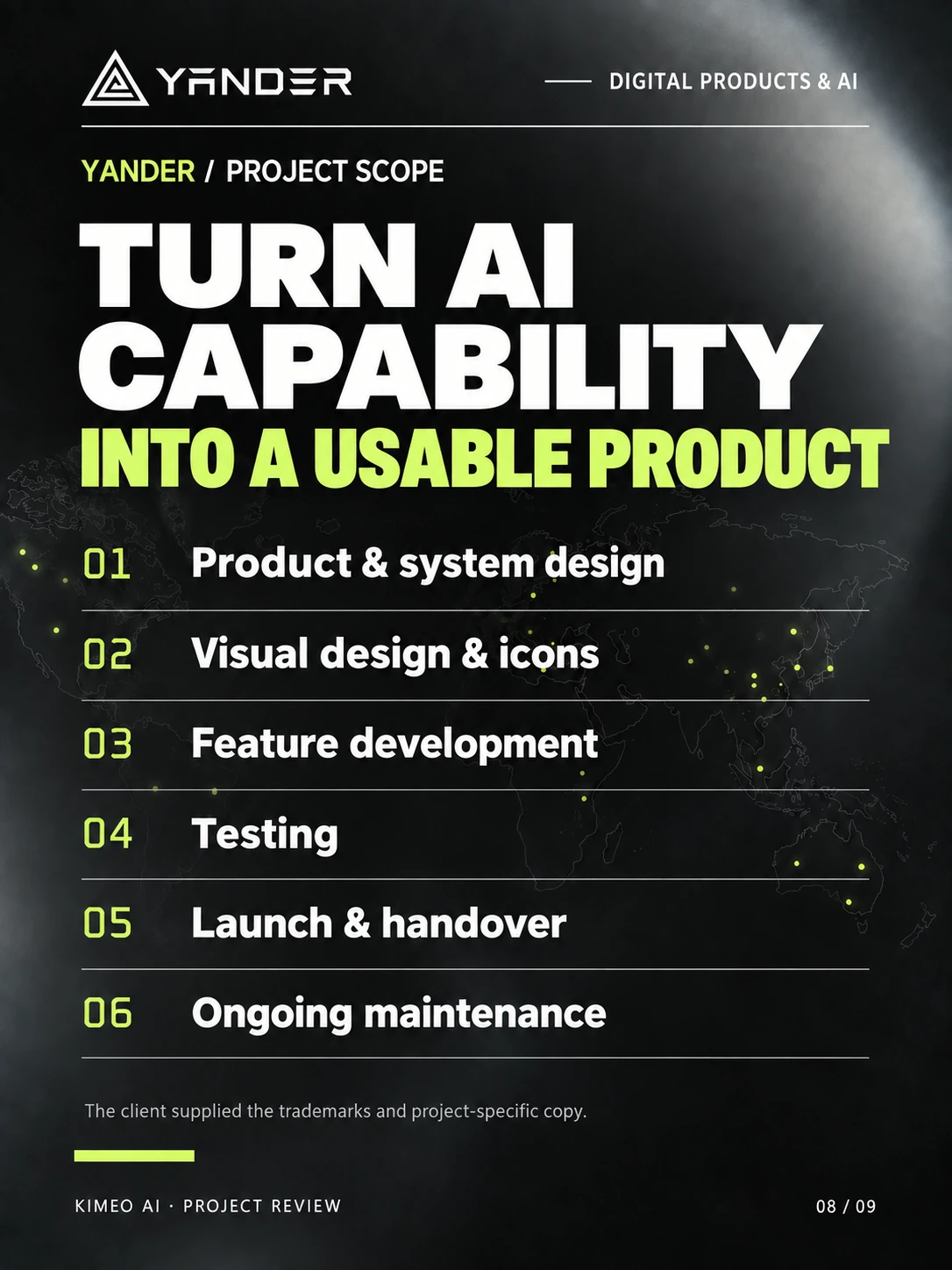
Explore the related work and delivery scope.
- Check an existing prototype
Prepare release evidence and decide what a team should take over.
- Scope an enterprise AI engagement
Understand FDE responsibilities, value, and continuing costs.
- Custom software & SaaS
Explore product design and engineering delivery.
Sources and scope
- GitHub Copilot: responsible use of inline suggestions
Official guidance on reviewing, testing, and validating generated code; it does not compare agency prices or promise project outcomes.
Decide what to keep building yourself
Share the task, current prototype, and delivery responsibilities you want to retain or hand over.
Discuss your build decision