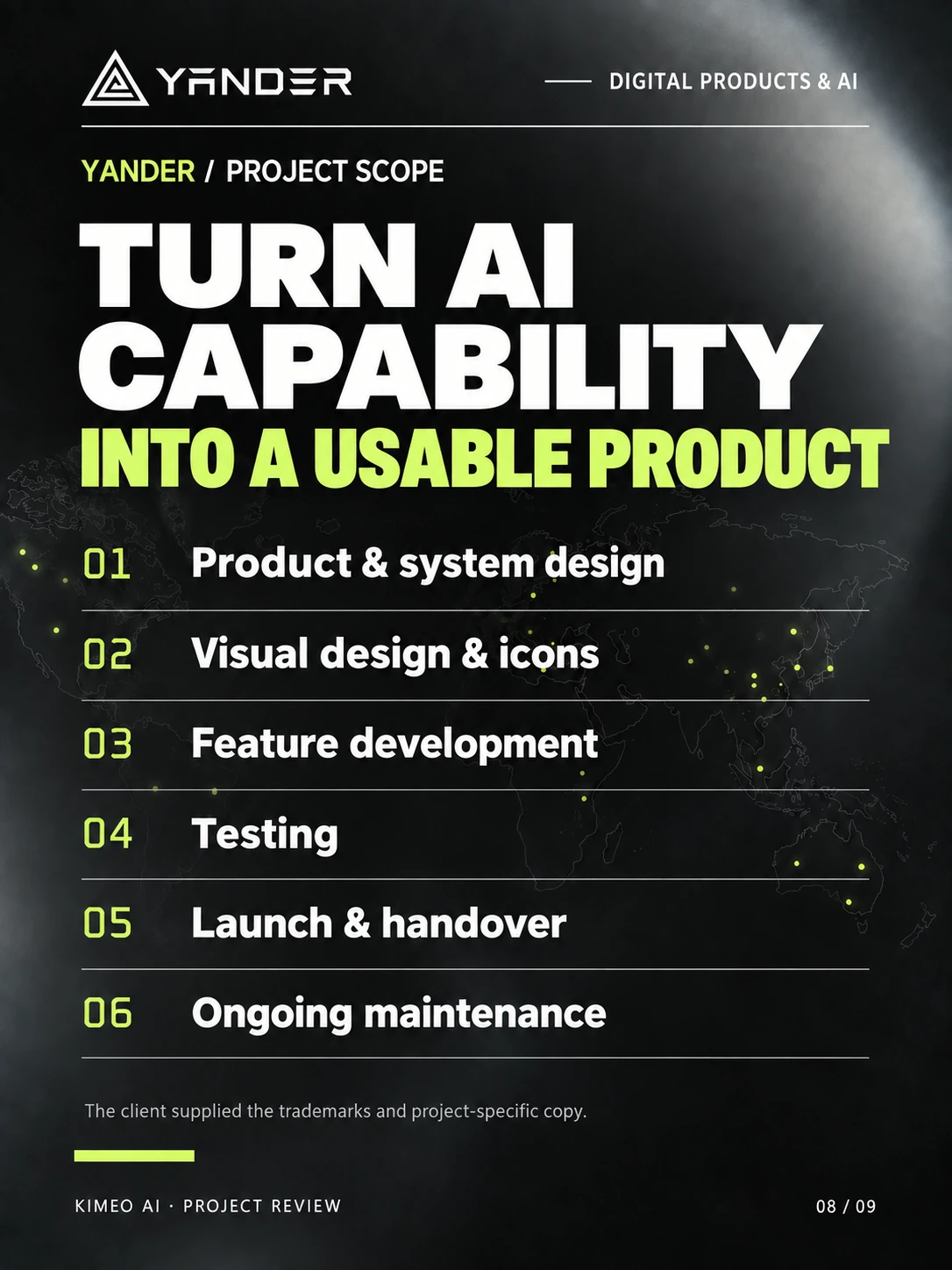
Enterprise AI and FDE: scope, responsibilities, costs, and value

6 min read
Quick answer
Consider FDE when an AI idea needs to be fitted to a real task, business data, existing systems, and the people who will use it. A standard tool or a defined software project may need less discovery.
Agree a bounded pilot, business owner, access, review, integration, acceptance, and operating handover. Compare value after human checking, exceptions, ongoing services, and maintenance.

FDE means forward deployed engineering. In this guide, it describes engineers working with business operators to understand and deliver a workflow in its actual setting.
On-site work, remote collaboration, availability, and support are engagement terms to agree. The label alone does not define staffing, response times, or responsibility for your whole AI roadmap.
Buy a completed task, not an unspecified agent
Describe the starting event, source systems, expected output, reviewer, and next action. Check whether a purchased product or a simpler rule-based change already solves the problem.
Illustrative scenario: a sales team turns an enquiry into a draft quote. The workflow needs current product information, pricing rules, missing-field checks, and a responsible approver before sending.
This scenario is not a delivered client result. A real pilot would need authorized samples, agreed rules, system access, and a baseline for the existing process.
Agree boundaries and responsibilities before access
A supplier can build the workflow, but your team must still supply a person who can decide what good work means. Identify domain reviewers and the owners of the systems being connected.
| Area | Agreement to record |
|---|---|
| Task and boundaries | The first workflow, users, exclusions, and actions requiring approval. |
| Data and systems | Authorized sources, permitted use, credentials, environments, and retention needs. |
| Delivery evidence | Representative samples, acceptance criteria, findings, and change handling. |
| Ownership | Repository, accounts, source code, reusable components, and third-party terms. |
| Operations | Monitoring, incidents, model or integration changes, handover, and support scope. |
Separate initial delivery from continuing cost
Ask for assumptions on volume, integrations, review, and data preparation. The initial pilot price and the operating cost answer different questions. Uncertain access or poor source data can change both.
| Cost area | Work or usage to clarify |
|---|---|
| Discovery and pilot | Task observation, samples, baseline, prototype, and evaluation. |
| Data preparation | Source cleanup, access, permissions, retrieval, and updates. |
| Product and integrations | Interface, roles, APIs, job states, approval, and existing-system changes. |
| External services | Models, hosting, storage, search, and other provider usage. |
| Human operation | Checking, corrections, exceptions, training, and process ownership. |
| Continuing change | Monitoring, upgrades, new requirements, support, and exit or migration. |
Measure accepted work against the manual baseline
Record comparable completed tasks before and during the pilot. Include active work, review, rework, waiting, and exceptions. A faster draft is useful only if the overall task improves.
Estimate net recurring value from observed work saved or capacity gained, less added review, services, and maintenance. Keep quality and failure consequences visible beside the estimate.
Use your actual task volume and agreed measurement period. Treat wider adoption and revenue effects as hypotheses until observed; do not count every generated result as accepted output.
Use a pilot to earn the next stage
Agree when to stop, revise, or expand. Continue only when the task helps operators, important failure paths are understood, and someone can own production use.
OWASP’s guidance helps identify AI application risks. NIST’s voluntary framework supports risk management across design, development, use, and evaluation. Neither is a supplier certificate or a guaranteed outcome.
Choose the first task with the workflow selection guide, then use the handover guide to define what the team must be able to run.
Put this into practice
Explore the related work and delivery scope.
- Enterprise AI and FDE delivery
Explore workflow discovery, integration, and controlled delivery.
- Choose the first AI workflow
Find a task with inputs, an owner, and measurable completion.
- Plan adoption and operational handover
Define ownership after the pilot.
Sources and scope
- OWASP GenAI LLM Top 10 2026
A technical risk reference for AI applications; it does not prescribe an FDE commercial package.
- NIST AI Risk Management Framework
A voluntary framework with a generative AI companion profile; not evidence of supplier certification.
See how an AI workflow engagement is scoped
Review the service approach, then bring a task, its source systems, and the person who owns the process.
Explore enterprise AI & FDE